Hitching 3 tonnes of caravan or camper trailer to your vehicle changes everything. It changes how you steer, how you stop, and how you react in an emergency.
While our calculator helps you get the weights legal, staying safe on the road requires a different set of skills. Whether you’re towing a box trailer to the tip or a 24ft caravan around Australia, these principles will keep your rig upright and your family safe.
Check My Towing Setup →Towing Stability Fundamentals
1. The 10% Rule (The Lever Effect)
The single biggest cause of trailer instability is poor weight distribution. It isn’t just about GVM; it is about where the Centre of Gravity (COG) sits.
The Golden Rule: You generally want 10% of the loaded trailer’s weight resting on the tow ball. This helps keep the mass forward of the axles.
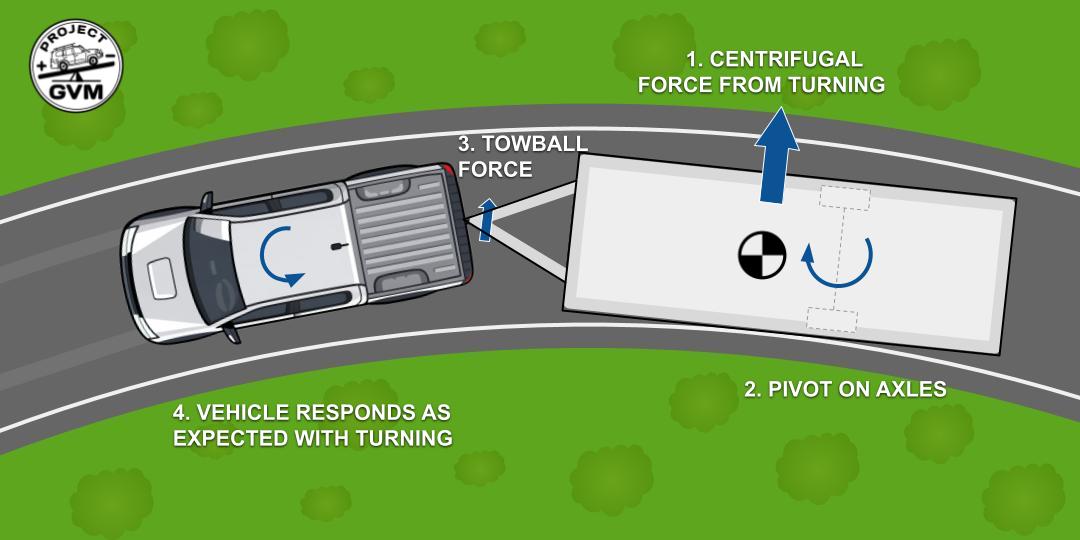
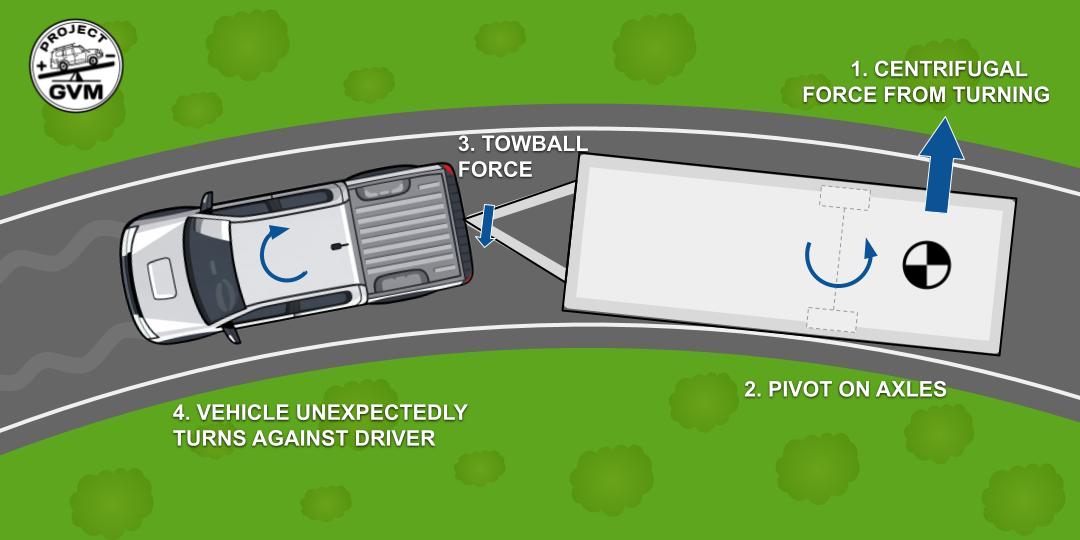
As shown in Figure 2, if you load too much weight at the back (behind the axles), the caravan becomes a lever. When you turn into a corner, the momentum of that rear weight pivots on the axle and pushes the tow ball in the opposite direction.
This creates a “pendulum” effect. The caravan actively fights the tow vehicle, straightening the car out against the driver’s steering input. This is a primary cause of unexpected understeer and jackknifing.
Important: Tow ball download counts as payload on your vehicle and reduces available GVM and rear axle capacity. Use the Project GVM Calculator to check your setup.
2. The Hill Trap (Static vs. Dynamic Weight)
After seeing the pendulum effect above, you might ask: Why don’t we just put the weight directly over the axles?
It seems like the perfect solution—perfect balance means no lever effect, right? While that works on a flat driveway, the game changes completely when you hit a hill.
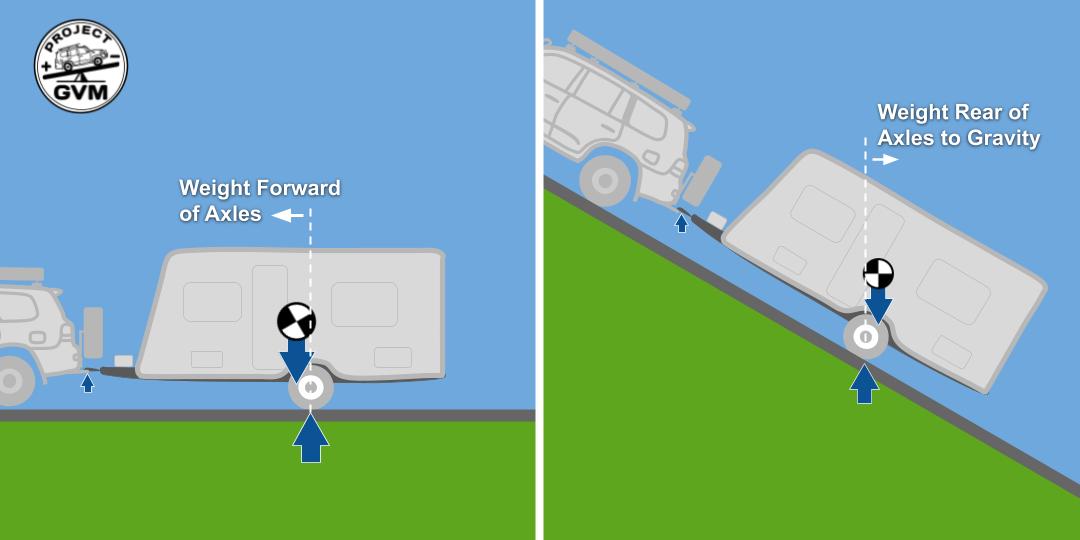
If you have “perfect” balance on flat ground (zero tow ball weight), gravity works against you on an incline. As seen in Figure 3, the vertical pull of gravity moves behind the tyre contact patch. This creates negative lift on the hitch.
The Consequence: This upward force lifts the rear of your tow vehicle, and behaves like the dangerous rear-biased setup shown in Figure 2.
This is why we need an 8%–12% buffer: it helps keep the tow ball heavy enough, even on steep ascents, without placing the load so far forward that handling becomes unpredictable.
3. The “Pre-Flight” Walkaround
Treat your rig like an aircraft. Before you pull out of the driveway or leave a campsite, do a physical walkaround. Do not rely on memory.
- Hitch Locked? Visually check the coupling is locked onto the ball.
- Chains Crossed? Safety chains should be crossed under the hitch to catch the drawbar if it detaches.
- Lights: Check indicators and brake lights (use a reflection in a window or ask a spotter).
- Handbrake: Ensure the trailer handbrake is fully released.
- Jockey Wheel: Double-check it is swung up and locked tight.
4. Speed vs. Stability
Just because the speed limit is 110km/h doesn’t mean you should tow at 110km/h. Most trailer sway incidents occur at higher speeds where aerodynamic drag creates turbulence.
The Sweet Spot: Many seasoned tourers stick to 90–100km/h. You save fuel, reduce mechanical stress, and give yourself a buffer to react if the lever effect kicks in.
5. Handling Trailer Sway
If your trailer starts to sway (snake) behind you, your natural instinct will be to slam on the brakes. Do not do this. Braking hard while the trailer is swinging can cause it to jackknife instantly.
What to do instead:
- Stay calm: Do not make sudden steering inputs.
- Ease off the accelerator: Let the vehicle slow down naturally.
- Use the trailer brakes: If you have an electric brake controller (like a Redarc), manually override it to apply only the trailer brakes. This pulls the trailer straight again, like pulling a piece of string taut.
Trailer sway is usually a weight and balance issue, not a driving issue. Check your weight distribution
6. Overtaking: The Patience Game
You are now a “Long Vehicle.” Overtaking requires significantly more clear road than you think.
- Momentum: You don’t have the acceleration to zip around a road train.
- Suction: As you pass a large truck, air pressure changes can pull your trailer toward the truck. Keep a wide berth.
- Downhill: Never overtake downhill. Gravity is already destabilising your rig; adding speed increases the risk of sway.
The One Thing Every Safe Tower Does
Experienced towers don’t guess, they calculate. GVM, GCM, axle loads and tow ball download must all work together.
If you’re towing a caravan, camper or trailer, especially with accessories or passengers, you owe it to yourself to check.
Calculate My Towing Setup →